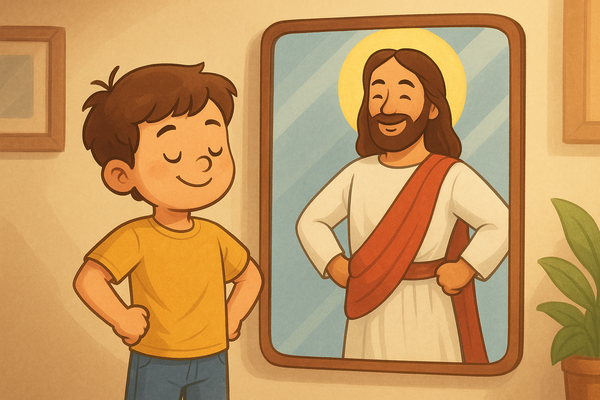
Fear of the Lord: The Path to Wisdom and Lasting Peace


What soap, scripture, and Solomon taught me about discipline and destiny.
When I was eight, my mom washed my mouth out with soap.
For many of us, this is a pivotal moment in gaining respect for our parents. I remember standing in the doorway to the garage, upset that my mom wasn’t letting me do what I wanted (most likely something disciplinary), and I was fed up. Under my breath, I said, “Stupid mom.”
She heard me from the garage and asked, “What did you say?”—tempting me to repeat it. For whatever reason, my audacious little self thought this was my moment to show her how angry I was. I lifted my head, looked her straight in the eyes, and said:
“STUPID. MOM.”
I quickly learned my lesson. She replied, “Looks like we’re going to have to wash out your mouth with all those dirty words.” And she did exactly that.
Do we really “fear” the Lord?
That moment stuck with me—and honestly, I still attribute it to the reason I don’t curse much, if at all, even at my worst. It was also a valuable lesson in what it meant to respect my mom. I never tried something that bold again.
Many of us claim we respect our parents. But how does that respect hold up when we leave the house and are no longer under their “jurisdiction”?
The fear of the Lord is similar to the respect we show our parents—but it goes even further. It’s not just about avoiding rebellion or doing what’s morally right (like not cussing as an adult). It’s about stepping into obedience and living a prudent life rooted in reverence for God.
When we adopt a true understanding of what it means to fear the Lord, we gain wisdom, insight, and guidance for our lives and our calling.
What does the Bible say about fearing the Lord?
I’ve mentioned before that I was a difficult child. I had to do everything my way or learn the hard way. I made life 10x harder by refusing to listen to advice, convinced I had to experience everything on my own.
In the same way, Proverbs opens with King Solomon saying:
“These are the proverbs of Solomon, David’s son, king of Israel.
2 Their purpose is to teach people wisdom and discipline, to help them understand the insights of the wise.
3 Their purpose is to teach people to live disciplined and successful lives, to help them do what is right, just, and fair.
4 These proverbs will give insight to the simple, knowledge and discernment to the young.
5 Let the wise listen to these proverbs and become even wiser. Let those with understanding receive guidance
6 by exploring the meaning in these proverbs and parables, the words of the wise and their riddles.
7 Fear of the Lord is the foundation of true knowledge, but fools despise wisdom and discipline.” (Proverbs 1:1–7)
Fearing the Lord means honoring His instruction and obeying His Word to live prudently as an example of Christ.
Would you say I truly feared my mom just because I didn’t say “stupid” again? Not really—because for much of my life, I still chose to do what I wanted. And honestly, I still struggle to listen to her at times.
In the same way, we can struggle to obey the wisdom God has already given us. Yet Proverbs tells us this fear of the Lord is the foundation of true knowledge.
So what holds us back from fully embracing it?
What’s holding us back from trusting God?
Solomon outlines three big reasons:
1. They love their own way more
“They hated knowledge and did not choose the fear of the Lord.” (Proverbs 1:29–30)
This is willful disobedience. We know what’s right. We hear it. We feel God’s conviction. But we still choose our own way.
Sometimes it’s subtle—like choosing what’s familiar instead of what God is prompting. Other times, it’s direct—choosing to return to sin even after we’ve experienced peace, joy, and freedom in Christ.
Peter puts it bluntly:
“For if, after they have escaped the defilements of the world through the knowledge of our Lord and Savior Jesus Christ, they are again entangled in them and overcome, the last state has become worse for them than the first.”
“What the true proverb says has happened to them: ‘The dog returns to its own vomit.’” (2 Peter 2:20–22)
2. They’re complacent or comfortable
“The complacency of fools will destroy them.” (Proverbs 1:32)
This trap hits hardest when things seem to be “working.” Maybe we’ve lived one way for years and think, “It’s fine, this is just how I am.” But God’s calling us to something greater.
We begin trusting our experience more than His instruction.
It’s like building a bike from a box without instructions. You’ve done it so many times, it works—but you never realized the box actually contained two unicycles made for something more meaningful, more collaborative, and more adventurous.
3. They’re distracted by immediate pleasure
“My child, don’t go along with them! Stay far away from their paths. They rush to commit evil deeds.” (Proverbs 1:15–16)
We love quick wins, easy comfort, instant gratification.
After a long day, it’s easy to reach for a drink, binge a show, or scroll aimlessly. I’ve been guilty of this too. But God invites us to something deeper.
He wants to be our refuge, our peace, our ever-present help in trouble (Psalm 46:1). He wants us to draw from the well that never runs dry.
“You will keep in perfect peace those whose minds are steadfast, because they trust in you.” (Isaiah 26:3)
What does growing in the fear of the Lord look like?
Back in Proverbs 1, Solomon says:
“Their purpose is to teach people wisdom and discipline, to help them understand the insights of the wise.” (v.2)
So how do we grow?
We listen. We obey. We honor God’s Word. We live lives that reflect His character.
As Proverbs continues, Solomon gives practical, everyday wisdom to follow—if we’ll just trust God enough to apply it.
He ends Proverbs 2 with this promise:
“For the upright will live in the land, and the blameless will remain in it.” (Proverbs 2:21)
To the Israelites, “the land” meant peace. It meant promise fulfilled. It meant home.
Today, that same peace is available to us. A life rooted in godly wisdom and reverence leads us to:
- Deeper understanding
- Spiritual maturity
- Lasting peace
- God’s presence and protection
God is a keeper of promises. If we live in awe of His Word and walk in obedience, He will lead us into a life full of purpose, joy, and peace.
Let the fear of the Lord be your foundation. From there, wisdom will grow—and with it, the life you were made for.
💬 Subscribe below for more reflections like this as we keep growing in truth, discipline, and the unshakable peace that comes from walking with God.